
Early intervention · 18 months to 6
Early intervention ABA, built around play.
BCBA-written ABA for toddlers and preschoolers, taught through play at home or at nursery, with you coached alongside.
Early intervention ABA, at a glance
Updated
- Age
- Typically from about 18 months to six, whenever you, your nursery or your paediatrician has a concern about how your child is developing.
- What it looks like
- Short, playful teaching built into toys, snacks, songs and daily routines, written by a BCBA and delivered by an RBT.
- Hours
- Intensive early intervention usually runs more hours than a typical home programme; the BCBA recommends a number and your family decides.
- Diagnosis
- Not needed to talk to us. You can start the conversation while an assessment or diagnosis is still being arranged.
The early years
When you are worried now, not in a year's time.
Maybe your toddler is not using words yet, does not turn when you call their name, or finds every change in the day overwhelming. Maybe a nursery teacher has mentioned something. Early intervention means acting on that worry while your child is young, building communication, play and everyday skills in the years when so much of that learning normally happens.
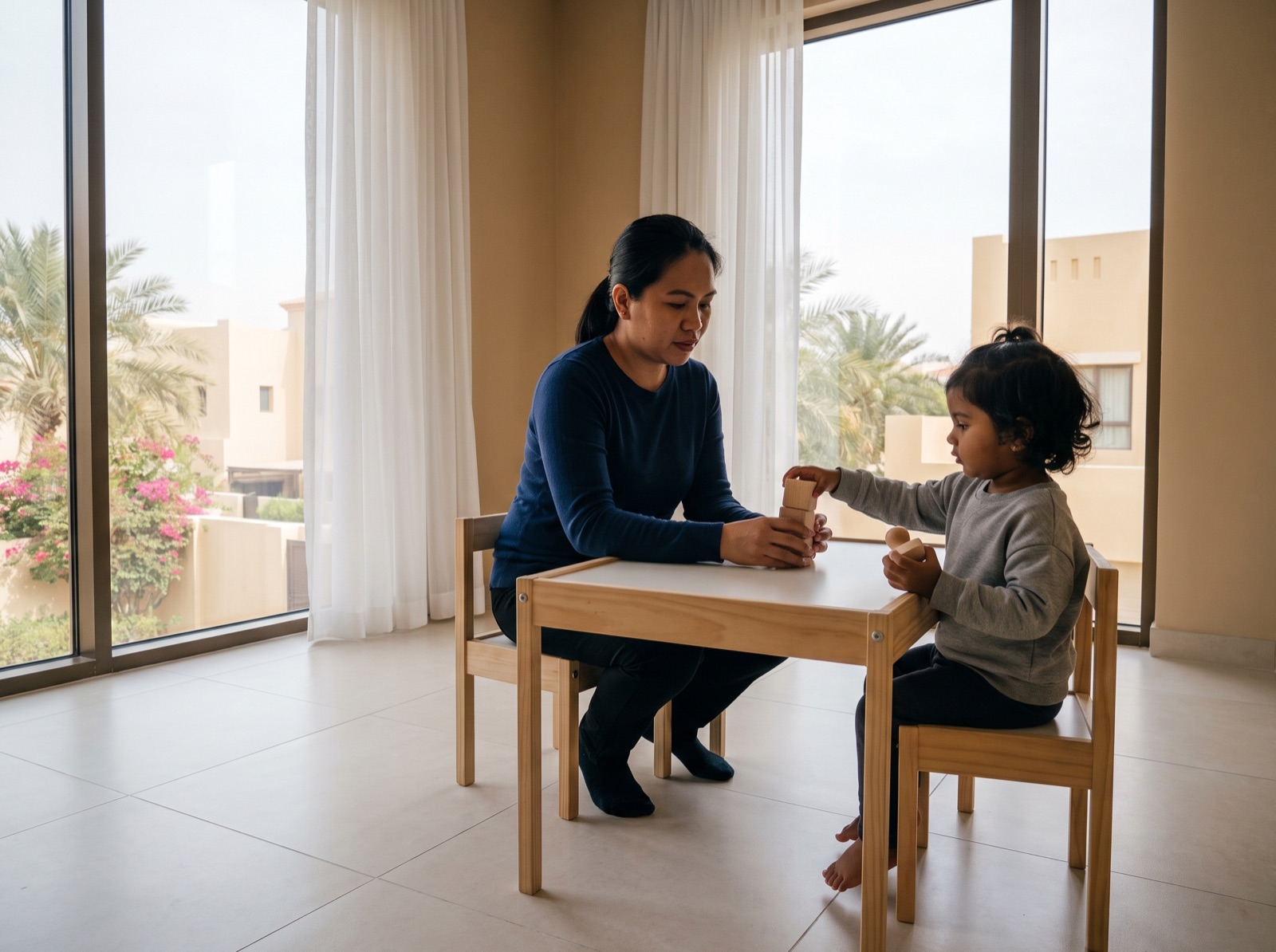
Early intervention ABA for this age looks nothing like a classroom. A BCBA writes goals around the things your child already loves — a favourite toy, bubbles, a song, snack time — and an RBT teaches through them in short, playful turns. Asking for things, copying, sharing attention and play are usually where it starts, and each is measured every session so you can see what is being learned.
You are at the centre of it. A toddler spends most waking hours with family, not with a therapist, so parent coaching is part of every programme: you learn to set up the same small teaching moments at bath time, in the car and at the dinner table. Sessions can run at home, at your child's nursery with its agreement, or both.

What early intervention works on
The first skills everything else builds on.
Asking for things
Reaching, pointing, a sign, a picture, a sound or a word — whatever your child can use today to get what they want without frustration taking over.
Looking and sharing
Following your point, showing you something, taking turns with a toy: the shared attention that conversation later grows out of.
Copying
Copying actions, sounds and play is one of the main ways young children learn, so it is often taught directly.
Play
Widening the ways your child plays, from one favourite activity towards pretend play and play alongside another child.
Everyday routines
Sitting for a meal, washing hands, getting dressed, toilet readiness and coping with transitions such as leaving the park.
Getting ready for nursery and FS1
Coping in a group, following a simple instruction and sitting for a story, so a classroom becomes a place your child can join in.
Intensive, not rigid
What EIBI means for a young child.
More hours, carefully chosen
Early intensive behavioural intervention (EIBI) means more weekly hours at a young age. The BCBA recommends the number from your child's needs; you decide what your family can sustain.
Short moments inside a session
A toddler's attention is short, so a session is made of brief teaching moments, breaks and play — not an hour at a table.
Comfort comes first
A good programme watches whether your child is happy and willing, and changes the approach when they are not.
Room for other therapies
Your child may also need speech and language therapy or occupational therapy. The ABA hours are planned so the whole week stays manageable for a small child.
How it starts
From a first message to the first session.
- Step 1
Tell us what you are noticing
Your child's age, what worries you and what nursery has said, if anything. A diagnosis is not needed for this conversation.
- Step 2
A BCBA sets first goals
AED 499 opens the search. The BCBA reviews the brief, sets first goals suited to your child's age and recommends the weekly hours and setting.
- Step 3
Coaching from the start
Your matched RBT begins at home or at nursery, and you are shown how to use the same strategies from the first weeks.
- Step 4
Reviewed as your child grows
Data is taken every session and the programme is reviewed with you monthly, because a young child's goals move on quickly.
Pricing
Two figures, both up front.
Open the search
AED 499
- A BCBA reviews your child's brief
- Goals and weekly hours recommended
- One matched RBT introduced
Sessions
From AED 325/hr
Confirmed in writing before the first session, and lower as the weekly hours go up. Billed for the sessions each month holds.
- Programme written and reviewed by a BCBA
- Data every session, review every month
- RBT replaced if the fit is wrong
More on ABA therapy
Related pages.
ABA therapy in Dubai
What ABA is, who it helps, and how our BCBA/RBT team runs it at home and at school.
Read moreSpeech delay in toddlers
When to act on a late talker, and what helps.
Read moreDevelopmental delay
Support for young children behind on several milestones at once.
Read moreAutism therapy in Dubai
ABA, speech and occupational therapy for autistic children, at home or at school.
Read moreABA therapy at home
One-to-one sessions in your own home, with the price and the register form on the page.
Read moreAssessment
A behavioural and educational assessment, then a clear recommendation.
Read moreFrequently asked
Questions families ask.
- What is early intervention ABA?
- Early intervention ABA is Applied Behaviour Analysis for very young children, usually under six, focused on the skills later learning builds on: communication, play, copying, shared attention and daily routines. For toddlers it is taught through play and everyday moments rather than at a table, and parents are coached to use the same strategies.
- What age can a child start early intervention ABA?
- There is no single starting age. Early intervention ABA is typically for children from around 18 months to six, once a parent, nursery or paediatrician has a concern. If you are worried, it is reasonable to ask now rather than wait to see whether your child catches up.
- Do we need an autism diagnosis before early intervention?
- No, not to talk to us. If a formal picture would help the programme, we say so before you pay anything. Our standalone assessment, at AED 499 with our Education and Program Director, is there for families who want one first.
- How many hours of early intervention does a toddler need?
- It depends on the child, and the BCBA recommends a figure after reviewing the brief and seeing your child. Intensive early intervention runs more hours than the two to three sessions a week many home programmes use, but more is not automatically better for a small child. You decide what your family can sustain.
- Is early intervention ABA only for autistic toddlers?
- No. It is often used with autistic toddlers, and also with young children who have global developmental delay, Down syndrome or a significant speech delay, to build communication, play and routines. The BCBA tells you whether ABA is the right fit for what you are seeing.
- Can early intervention sessions happen at nursery?
- Yes, if the nursery agrees. Nursery sessions let the RBT work on joining a group, following the routine and playing alongside other children, and we coordinate with the nursery's lead or SENCO. Programmes can combine nursery and home sessions.
- What will I be asked to do as a parent?
- To watch, ask questions and practise. Parent coaching is part of every programme, so you learn to set up the same small teaching moments during play, meals and bath time. A responsible adult is present for every home session, which makes it a natural time to learn.
- Will early intervention make my child talk?
- No one can honestly promise that, and a provider who does should be asked why. What a programme can do is teach communication in whatever form your child can use now — gestures, signs, pictures or words — and measure every session whether it is being learned.
- How is early intervention ABA different from speech therapy?
- Speech and language therapy focuses on communication: understanding, speech sounds, language and how it is used with others. Early intervention ABA works on communication too, but alongside play, routines and behaviour, and usually for more hours a week. Some children have both, and it helps when the therapists share goals.
Further reading
Guides for this decision.

Therapy
Early intervention ABA for toddlers in the UAE: what to expect
What early intervention ABA looks like for children from 18 months to six, what happens in the first months, and how therapy works alongside nursery.

Autism
Early signs of autism in toddlers — and what to do next
Common early indicators of autism in toddlers, and a practical next step if you're noticing them.
Therapy
Speech and language therapy for toddlers: when to start
How to tell whether your toddler's speech is a normal variation or worth a professional screening.
Therapy
How many hours of ABA therapy does my child need?
How ABA hours are actually decided, why more hours are not automatically better, and how to choose a weekly number your family can keep up for months.
Therapy
ABA parent coaching: strategies to use at home between sessions
What ABA parent coaching involves, and the strategies families use between sessions: reinforcement, visual schedules, first-then boards and choices.

Guides
When should a child see a developmental paediatrician? A parent's guide
What a developmental paediatrician actually does, when a referral makes sense, and why you don't need to wait for the appointment to start support.
Tell us about your child.
A conversation first, on WhatsApp or by phone. No obligation, and a straight answer if we are not the right fit.